


 Kody Nexov
 Published
Research-backed decision brief - checked 2026-07-24
iGaming Software Cost & Pricing Explained: the decision-ready answer
There is no decision-useful single market price without a fixed operating scenario. Compare one-off, recurring, usage, revenue-share, minimum, third-party, retained-team, change, and exit costs over the same term and volume assumptions.
The assigned US English query igaming software cost was checked on July 24, 2026. The result included People also ask, so concise answer structure and explicit source boundaries matter for both search and answer engines.
Evidence standard for this decision
Use Yes only when a current source or test explicitly supports the field; Partial when it supports only part of the scope; Not found when the reviewed public sources do not expose it; and Unknown when it has not yet been evaluated. Not found is not evidence that a capability is absent.
| Decision field | Evidence to request | Pass signal | Keep unresolved when |
|---|---|---|---|
| Scenario | Brands, markets, users, products, transactions, and support hours | Every quote uses the same low, base, and high case | Suppliers price different scopes |
| Cost boundary | Included and excluded supplier, third-party, and operator costs | Every line has an owner, unit, quantity, and timing | Implementation or retained staff are omitted |
| Contract mechanics | Minimums, indexation, change rates, term, renewal, and credits | Sensitivity can be recalculated from the schedule | Important charges remain in narrative text |
| Exit cost | Export, transition, parallel run, deletion, and termination fees | Replacement cost and time are visible before signature | Exit assistance is described as reasonable |
Questions observed in current demand
Relevant Search Console demand includes igaming software price, igaming software cost, software igaming valor. The questions below convert that demand into a buyer-verification task.
What does igaming software price cost, and which assumptions change the total?
Answer it with a normalized scenario and a complete cost boundary for iGaming Software Cost & Pricing Explained, not a single unsupported market figure. Mark public pricing as Not found when no comparable official schedule exists.
Question source: GSC query - igaming software price
What does igaming software cost cost, and which assumptions change the total?
Answer it with a normalized scenario and a complete cost boundary for iGaming Software Cost & Pricing Explained, not a single unsupported market figure. Mark public pricing as Not found when no comparable official schedule exists.
Question source: GSC query - igaming software cost
What is software igaming valor, who is it for, and what should a buyer verify?
There is no decision-useful single market price without a fixed operating scenario. Compare one-off, recurring, usage, revenue-share, minimum, third-party, retained-team, change, and exit costs over the same term and volume assumptions. Apply that evidence rule specifically to iGaming Software Cost & Pricing Explained and keep unverified product, price, market, and performance claims marked as unknown.
Question source: GSC query - software igaming valor
Acceptance scenarios
- Recalculate the quote at the base and high-volume case without asking the supplier for a new spreadsheet.
- Add one jurisdiction and one product vertical and trace every affected charge and retained duty.
- Model an early exit and a term-end migration, including data, parallel run, and replacement support.
Source boundary and next evidence
The linked study is the direct research source for this page's topic cluster. It publishes the sample or control set, field definitions, classifications, checked date, primary-source ledger, limitations, and downloadable data. It does not replace jurisdiction-specific legal advice, a supplier proposal, authenticated documentation, a production test, customer references, or a signed contract.
Read the provider platform research study or download its CSV dataset.
Protected cost-research update
Model setup, fixed, variable, retained-team, and exit cost together
There is no universal iGaming software price because delivery model, market, modules, integrations, transaction volume, managed services, and retained operator responsibilities change the cost base. Normalize every proposal into the same five cost layers before comparing headline fees.
| Cost layer | Include in the model | Question that exposes omissions |
|---|---|---|
| One-off delivery | Discovery, configuration, integrations, data migration, environments, certification support, training, testing, and launch | Which dependencies, third parties, travel, rework, and acceptance cycles are excluded from the fixed scope? |
| Fixed recurring | Platform minimums, hosting, environments, support tier, licences, monitoring, account management, and required modules | Which fees continue before launch, during suspension, or below the contracted volume threshold? |
| Variable usage | Revenue share, bets, transactions, game content, feeds, PSPs, KYC checks, messaging, storage, and bandwidth | What is the exact billing base, currency, tier, minimum, cap, pass-through rule, and audit method? |
| Retained operator team | Product, engineering, compliance, payments, finance, support, trading, risk, CRM, data, and supplier management | Which recurring workflows still require an internal owner, shift coverage, specialist tool, or external adviser? |
| Change and exit | Change requests, new markets, additional brands, export, parallel run, transition assistance, termination, and replacement implementation | What data, documentation, support, fees, and time are required to migrate without interrupting balances and reporting? |
What to do next
- Calculate low, base, and high-volume scenarios using one shared set of business assumptions.
- Separate known, estimated, supplier-reported, and unresolved inputs; do not hide unknowns inside a contingency percentage.
- Compare three-year cash cost, unit economics, internal staffing, downside commitments, and replacement cost, not setup fee alone.
Comparable three-year TCO formula
Use the same formula for each shortlisted proposal and retain a source, owner, and confidence label for every input.
| Term | Calculation | Required evidence |
|---|---|---|
| Delivery | All one-off supplier, third-party, internal, certification, migration, and launch costs | Signed scope, dependency list, rate card, acceptance plan, and internal resource estimate |
| Run-rate | 36 months of fixed recurring fees plus volume-based charges in each scenario | Complete pricing schedule, billing definitions, minimums, tiers, indexation, and pass-through rules |
| Retained operations | Internal and external team cost for the responsibilities not included in supplier scope | Responsibility matrix, staffing plan, coverage model, and tooling inventory |
| Risk allowance | Explicit expected cost for evidenced delivery and operating risks | Risk register with probability, impact, mitigation, owner, and trigger; not an unexplained percentage |
| Exit | Export, parallel run, transition support, replacement integration, and contractual termination cost | Exit schedule, tested export, assistance rates, notice periods, minimums, and migration plan |
The framework is for comparative planning, not a market-price promise. Currency, tax, legal, regulatory, financing, and jurisdiction-specific costs require current specialist review.
Pricing in iGaming software is rarely straightforward.
Two platforms may look similar on the surface, offer overlapping feature sets, and still end up with completely different total costs over time.
The reason is simple: you are not buying software alone. You are buying a mix of technology, compliance assumptions, integrations, and operational responsibility. Most pricing misunderstandings start when these layers are bundled together — or intentionally left vague.
This page does not aim to provide price lists. Instead, it explains how iGaming software pricing actually works, where costs usually appear, and why many operators underestimate the real budget required to run and scale a platform.
How iGaming Software Pricing Actually Works
At a high level, iGaming software pricing is structured around commercial models, not fixed products.
The same platform can be sold under different pricing logic depending on the operator profile, target markets, and expected volume.
In practice, pricing discussions usually fall into a few recurring models.
Common iGaming Pricing Models
| Pricing model | How it works | Typical risks |
|---|---|---|
| Upfront license fee | A fixed setup or licensing cost paid before launch, often positioned as a “one-time” payment. | Rarely covers full scope. Additional costs tend to appear later through integrations, updates, or support tiers. |
| Revenue share | The provider takes a percentage of gross gaming revenue instead of, or in addition to, upfront fees. | Can become expensive at scale. Often underestimated in long-term projections. |
| Monthly platform fee | A recurring fee covering core platform access and basic services. | Core features may be included, but many operational components remain outside the base fee. |
| Hybrid model | Combination of setup fees, monthly costs, and revenue share. | Harder to compare across providers. Requires careful breakdown to avoid double-paying. |
None of these models are inherently “good” or “bad”. The issue arises when operators compare offers without normalizing what is actually included in each model.
“Pricing discussions in iGaming are rarely about software alone. They are about how risk and responsibility are distributed.”
In most cases, software cost reflects assumptions about:
- expected transaction volume,
- regulatory exposure,
- operational complexity,
- and how much work remains on the operator’s side.
Understanding the pricing model is less about finding the cheapest option — and more about understanding where future costs are likely to surface.
What Usually Drives the Cost Up
In most iGaming projects, the initial software quote is not what determines the final budget.
Costs tend to grow later — quietly and incrementally — once the platform moves from a demo environment into real operations.
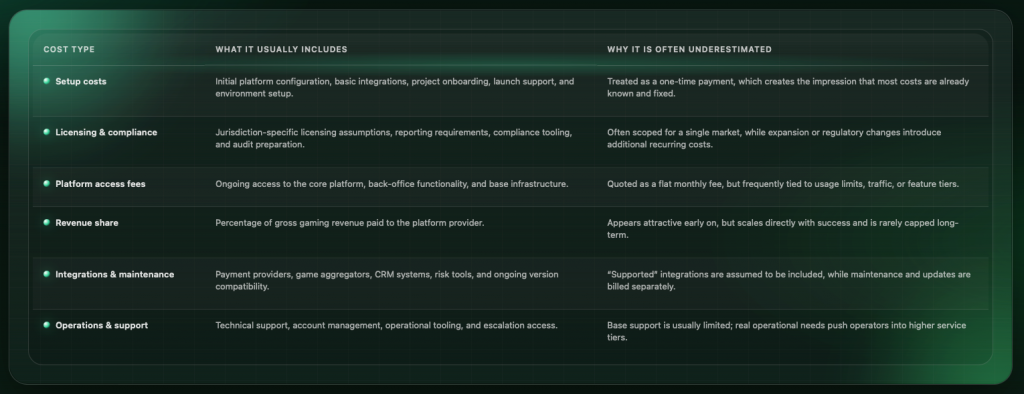
One of the most common drivers is regulatory scope. Pricing often assumes a limited licensing setup, while real-world operations introduce additional requirements: jurisdiction-specific compliance, reporting, KYC flows, or audit-related tooling. These elements are rarely part of a “base” platform package.
Another underestimated factor is integration depth. Payment providers, game aggregators, CRM tools, risk management systems, and third-party services are often presented as “supported”. In practice, supported does not always mean included. Custom integrations, ongoing maintenance, and version compatibility can quickly add recurring costs.
Operational tooling also plays a role. Back-office access, reporting flexibility, player management features, and operational permissions are frequently segmented across pricing tiers. What looks sufficient at launch may become limiting once volume increases or team structure evolves.
The result is rarely a single large cost increase. Instead, operators encounter a series of smaller additions that collectively reshape the budget over time.
“Most cost overruns in iGaming do not come from unexpected features. They come from expected features that were never fully priced.”
Setup Costs vs Ongoing Costs
One of the most common pricing mistakes in iGaming is treating launch costs as the primary budget reference.
In reality, setup expenses are usually the smallest and most predictable part of the overall cost structure.
What matters more is how costs behave after launch — once the platform is live, regulated, integrated, and operating under real load.
To avoid confusion, it helps to separate costs into two distinct categories.
Typical Cost Breakdown
| Cost type | What it usually includes | Why it is often underestimated |
|---|---|---|
| Setup costs | Platform onboarding, initial configuration, basic integrations, launch support. | Often presented as a “one-time” fee, creating a false sense of cost certainty. |
| Ongoing costs | Platform fees, revenue share, compliance updates, integrations maintenance, support tiers. | Spread over time and tied to growth, making them harder to forecast accurately. |
Setup costs are usually discussed early and in detail. They are visible, finite, and easy to approve internally.
Ongoing costs, on the other hand, tend to surface gradually — especially as operational complexity increases.
This becomes particularly noticeable when:
- additional markets are added,
- transaction volume grows,
- or new integrations are required post-launch.
In many cases, operators realise that the platform itself was not the main expense. The real cost lies in keeping the platform compliant, connected, and operational as the business evolves.
“The launch budget is often approved with confidence. The operational budget is where assumptions start to fail.”
Understanding this distinction early helps frame provider conversations more realistically. It shifts the focus from how much does it cost to launch to how much does it cost to operate and scale.
Cheap Software: Where the Catch Usually Is
Low-cost iGaming software offers are rarely misleading on purpose.
More often, they are incomplete by design.
A platform may appear affordable because it assumes a narrow operational scope: a limited number of integrations, a single jurisdiction, minimal reporting requirements, or low transaction volume. Within those boundaries, the pricing can be perfectly reasonable.
Problems tend to emerge when real operations start to diverge from those assumptions.
A common pattern is that core functionality is priced attractively, while operational dependencies are monetised separately. Integrations, compliance tooling, reporting flexibility, or performance-related upgrades are introduced later, once switching platforms becomes costly.
Another frequent issue is support structure. Lower-priced platforms often include only basic support access. As operational load increases, response time, dedicated account management, or technical escalation may require moving into higher tiers.
In some cases, pricing reflects risk transfer rather than efficiency. The provider reduces upfront cost by shifting responsibility to the operator — whether for compliance interpretation, third-party coordination, or ongoing maintenance.
“Cheap platforms are rarely cheap because they are simpler. They are cheap because they assume less responsibility.”
This does not make such solutions unusable. For certain projects, especially with limited scope or short-term objectives, lower-cost software can be a pragmatic choice. The issue arises when operators expect long-term scalability from a model that was priced for minimal complexity.
Understanding where responsibility sits — and how that responsibility is priced — is often more important than the headline number on the proposal.
How to Evaluate Pricing Offers
Evaluating iGaming software pricing is less about comparing numbers and more about comparing assumptions.
Two proposals may look similar on paper while being built on very different operational expectations.
A useful starting point is to clarify what the quoted price actually includes over time, not just at launch. This often reveals whether ongoing obligations — compliance updates, integrations maintenance, or support depth — are treated as part of the core service or as optional add-ons.
It is also worth examining where flexibility sits. Some platforms price stability aggressively but charge for change. Others appear more expensive upfront while allowing operational adjustments without constant renegotiation. Neither approach is inherently better, but they suit different growth trajectories.
Finally, pricing should be evaluated in the context of exit cost. Migration complexity, data portability, and contractual lock-ins rarely feature prominently in early discussions, yet they play a significant role once the platform is live.
A simple rule tends to hold:
if a pricing model is hard to explain internally, it will likely be hard to manage operationally.
A Practical Perspective
iGaming software pricing is not designed to be transparent by default. It reflects risk allocation, regulatory exposure, and long-term operational responsibility as much as technical capability.
The most reliable way to approach it is not to search for the lowest number, but to understand what that number assumes — and what happens when those assumptions change.
In many projects, the right platform is not the cheapest or the most expensive one. It is the one whose pricing logic remains understandable six or twelve months after launch, when real operational pressure replaces initial projections.
That clarity is often what separates sustainable platforms from those that require constant renegotiation.
Concept map
Related concepts and decision guides
- TCO calculator
- Build a comparable planning scenario for supplier, retained-team, third-party, change, and exit costs without submitting data.
- iGaming Software Buyer Guides
- Move from initial software research to a documented shortlist, cost model, RFP, and implementation plan.
- Sportsbook Software Public-Evidence Study 2026 guide
- Compare the public procurement evidence disclosed by seven sportsbook technology offerings without treating marketing visibility as product quality.
- iGaming Managed Services guide
- Decide which operational responsibilities to outsource and which must stay with the operator.
- iGaming Software Implementation Timeline
- Estimate a realistic launch sequence from contracting through controlled go-live.
Evidence layer
Primary references and verification limits
Sources were checked on . They support the standards and verification questions used in this guide. They do not prove a supplier-specific price, market eligibility, implementation result, or private product claim; buyers should request current, versioned evidence for those points.
- iGaming Solution - provider platform research 2026 Original publisher research. A dated methodology, evidence matrix, primary-source ledger, limitations, and downloadable CSV supporting this page's decision framework.
- AWS Well-Architected — Reliability Pillar Cloud architecture guidance. Availability targets, resilience testing, incident learning, recovery objectives, capacity, and dependency management.
- NIST Cybersecurity Framework 2.0 Government standards body. Cybersecurity governance, risk management, protection, detection, response, and recovery outcomes.
- UK Gambling Commission — Remote gambling and software technical standards Regulator. Remote gambling software controls, security requirements, player-facing technical controls, and jurisdiction-specific verification questions.
- UK Gambling Commission — Testing strategy for remote gambling software Regulator. Testing, release control, audit evidence, change management, independent review, and production assurance questions.