


 Kody Nexov
 Published
Research-backed decision brief - checked 2026-07-24
iGaming Software Solutions for Operators: the decision-ready answer
There is no universal best option. Freeze the operator profile, jurisdiction, product boundary, delivery model, retained team, timeline, and risk tolerance; compare like-for-like evidence; and keep public unknowns unresolved until an RFP, demo, test, reference, or contract closes them.
The assigned US English query igaming solutions was checked on July 24, 2026. The result included People also ask, so concise answer structure and explicit source boundaries matter for both search and answer engines.
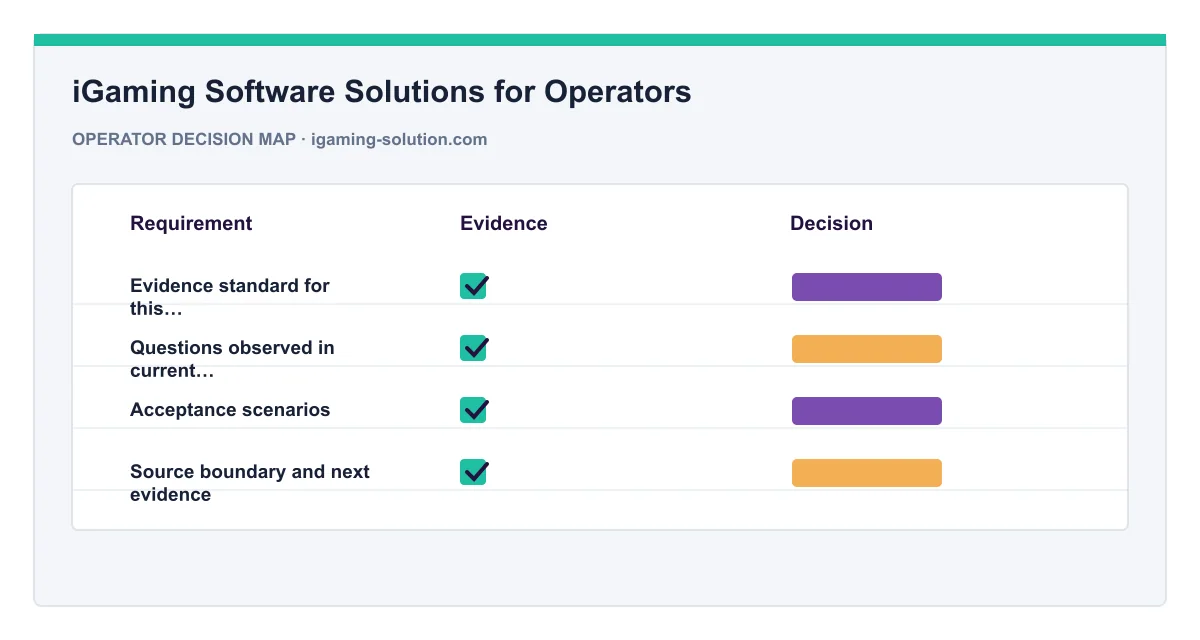
Evidence standard for this decision
Use Yes only when a current source or test explicitly supports the field; Partial when it supports only part of the scope; Not found when the reviewed public sources do not expose it; and Unknown when it has not yet been evaluated. Not found is not evidence that a capability is absent.
| Decision field | Evidence to request | Pass signal | Keep unresolved when |
|---|---|---|---|
| Comparison set | One buyer profile and explicit inclusion and exclusion rules | Candidates solve the same layer and operating problem | Platforms, modules, services, and content are mixed |
| Capability evidence | Current official documentation and buyer-owned workflow tests | Yes, Partial, Not found, and Unknown remain distinct | Feature count replaces evidence quality |
| Delivery fit | Responsibility, integration, staffing, market, and implementation map | Retained duties and dependencies are affordable and owned | Turnkey is interpreted as no operator work |
| Commercial and exit | Normalized TCO, SLA, data rights, transition, and remedies | The shortlist remains viable under a high case and an exit case | Only headline price and launch speed are compared |
Questions observed in current demand
Relevant Search Console demand includes igaming solutions, igaming software, software solutions for igaming. The questions below convert that demand into a buyer-verification task.
What is igaming solutions, who is it for, and what should a buyer verify?
There is no universal best option. Freeze the operator profile, jurisdiction, product boundary, delivery model, retained team, timeline, and risk tolerance; compare like-for-like evidence; and keep public unknowns unresolved until an RFP, demo, test, reference, or contract closes them. Apply that evidence rule specifically to iGaming Software Solutions for Operators and keep unverified product, price, market, and performance claims marked as unknown.
Question source: GSC query - igaming solutions
What is igaming software, who is it for, and what should a buyer verify?
There is no universal best option. Freeze the operator profile, jurisdiction, product boundary, delivery model, retained team, timeline, and risk tolerance; compare like-for-like evidence; and keep public unknowns unresolved until an RFP, demo, test, reference, or contract closes them. Apply that evidence rule specifically to iGaming Software Solutions for Operators and keep unverified product, price, market, and performance claims marked as unknown.
Question source: GSC query - igaming software
What is software solutions for igaming, who is it for, and what should a buyer verify?
There is no universal best option. Freeze the operator profile, jurisdiction, product boundary, delivery model, retained team, timeline, and risk tolerance; compare like-for-like evidence; and keep public unknowns unresolved until an RFP, demo, test, reference, or contract closes them. Apply that evidence rule specifically to iGaming Software Solutions for Operators and keep unverified product, price, market, and performance claims marked as unknown.
Question source: GSC query - software solutions for igaming
Acceptance scenarios
- Score every candidate against the same evidence rule and preserve Not found instead of converting it to No.
- Run the same critical workflow and failure case in each shortlisted product or environment.
- Compare the base, high-volume, delayed-launch, and exit scenario before ranking suppliers.
Source boundary and next evidence
The linked study is the direct research source for this page's topic cluster. It publishes the sample or control set, field definitions, classifications, checked date, primary-source ledger, limitations, and downloadable data. It does not replace jurisdiction-specific legal advice, a supplier proposal, authenticated documentation, a production test, customer references, or a signed contract.
Read the provider platform research study or download its CSV dataset.
Intent clarification
Choose the software layer before choosing a supplier
The broad query iGaming software can mean a full operator platform, casino aggregation, sportsbook, payments, compliance tooling, CRM, affiliate tracking, or custom development. This page is the category map; provider rankings and technical module reviews live on their dedicated pages.
| Need | Typical software layer | Next decision |
|---|---|---|
| Run player accounts and balances | PAM and wallet | Define system of record, ledger ownership, permissions, and export |
| Add casino content | Game aggregator and studio contracts | Confirm live catalogue, market rights, wallet calls, and certification |
| Add sports betting | Sportsbook core, feeds, trading, and risk | Choose operating model and test peak-event workflows |
| Launch with outsourced scope | White label or turnkey | Map retained regulated duties and exit rights |
| Connect specialist services | APIs for payments, KYC, CRM, data, and affiliates | Set versioning, observability, reconciliation, and SLA requirements |
A request for iGaming software is not specific enough for a comparable quotation. Start by defining the operating model and required software layers.
Choosing iGaming software is rarely about features alone. For operators, software decisions define operational responsibility, regulatory exposure, and long-term scalability. What is often described as a “software solution” is, in practice, a broader operational model that shapes how an iGaming business is built and managed.
Unlike players, operators do not interact with games or interfaces as end users. Their primary concern is how technology supports compliance, payments, reporting, and day-to-day operations across markets. For this reason, iGaming software solutions are best understood through the lens of operational control rather than product functionality.
What iGaming Software Solutions Mean for Operators
For operators, an iGaming software solution represents the combination of platform architecture, delivery model, and operational responsibilities required to run an online gambling business.
This includes decisions around hosting, compliance ownership, integrations, reporting, and technical maintenance. Different solutions distribute these responsibilities differently between the operator and the technology provider.
As a result, the same software stack can feel lightweight for one operator and restrictive for another, depending on internal capabilities and strategic goals.
Main Types of iGaming Software Solutions
Most operator-facing iGaming software solutions fall into a small number of structural categories. The differences between them are less about features and more about control and responsibility.
| Solution type | Control level | Operational responsibility | Typical use case |
|---|---|---|---|
| Turnkey platform | Low to medium | Largely handled by provider | Fast market entry |
| Modular platform | Medium to high | Shared between operator and provider | Growing operators |
| White-label solution | Low | Mostly provider-driven | Brand-focused launches |
| Custom-built solution | High | Primarily operator-owned | Enterprise operations |
These categories describe architectural approaches rather than specific vendors or products.
How Operators Choose Between Solutions
Operators typically evaluate software solutions based on a limited set of practical considerations rather than technical ambition.
The most common decision drivers include:
- speed of launch versus long-term flexibility,
- regulatory scope and jurisdictional requirements,
- availability of internal technical and operational expertise.
Balancing these factors often determines whether an operator prioritizes simplicity or control.
Trade-offs Operators Often Underestimate
While the benefits of each solution type are usually clear upfront, the trade-offs tend to surface later.
Commonly underestimated factors include:
- the complexity of migrating platforms once operations are live,
- ongoing operational costs beyond initial setup,
- responsibility for compliance updates and regulatory changes.
These considerations rarely appear in early-stage comparisons but significantly affect long-term outcomes.
Why the Same Solution Does Not Fit Every Operator
No single iGaming software solution is universally optimal. What works for a startup entering one market may become restrictive for an operator expanding across jurisdictions.
Similarly, enterprise-grade solutions that offer maximum control may be unnecessarily complex for smaller brands. Operator maturity, regulatory exposure, and growth strategy ultimately determine which solution aligns best with business realities.
Understanding this context helps avoid decisions based solely on surface-level comparisons.
How This Relates to Casino, Sportsbook, and White Label Platforms
This page focuses on operator-oriented solution models, not on specific product categories.
Detailed discussions of casino-focused platforms, sportsbook technologies, and white-label providers are covered separately. Those pages explore product depth and delivery specifics, while this overview addresses how operators frame their software decisions at a strategic level.
Together, these perspectives provide a complete view without overlapping intent.
Related Operator-Focused Topics
Further reading includes iGaming casino software platforms, sportsbook software solutions, white-label delivery models, platform pricing structures, and compliance-oriented platform architecture.
Concept map
Related concepts and decision guides
- White Label iGaming Software Providers comparison
- White label solutions occupy a distinct position within the iGaming technology landscape.
- iGaming software provider
- Online casinos rely on specialized software platforms to manage game content, player accounts, payments, and regulatory requirements.
- iGaming Solution Providers
- The iGaming technology market continues to evolve rapidly, driven by regulatory changes, platform consolidation, and increasing operational complexity.
- iGaming Platform Providers & Technology
- The iGaming industry relies on a complex network of technology providers that operate largely behind the scenes.
- Sportsbook Software Public-Evidence Study 2026
- Compare the public procurement evidence disclosed by seven sportsbook technology offerings without treating marketing visibility as product quality.
Evidence layer
Primary references and verification limits
Sources were checked on . They support the standards and verification questions used in this guide. They do not prove a supplier-specific price, market eligibility, implementation result, or private product claim; buyers should request current, versioned evidence for those points.
- iGaming Solution - provider platform research 2026 Original publisher research. A dated methodology, evidence matrix, primary-source ledger, limitations, and downloadable CSV supporting this page's decision framework.
- AWS Well-Architected — Reliability Pillar Cloud architecture guidance. Availability targets, resilience testing, incident learning, recovery objectives, capacity, and dependency management.
- NIST Cybersecurity Framework 2.0 Government standards body. Cybersecurity governance, risk management, protection, detection, response, and recovery outcomes.
- UK Gambling Commission — Remote gambling and software technical standards Regulator. Remote gambling software controls, security requirements, player-facing technical controls, and jurisdiction-specific verification questions.
- UK Gambling Commission — Testing strategy for remote gambling software Regulator. Testing, release control, audit evidence, change management, independent review, and production assurance questions.