


 Kody Nexov
 Published
Research-backed decision brief - checked 2026-07-24
White Label iGaming Software Providers: the decision-ready answer
There is no universal best option. Freeze the operator profile, jurisdiction, product boundary, delivery model, retained team, timeline, and risk tolerance; compare like-for-like evidence; and keep public unknowns unresolved until an RFP, demo, test, reference, or contract closes them.
The assigned US English query white label igaming software was checked on July 24, 2026. The result included People also ask, so concise answer structure and explicit source boundaries matter for both search and answer engines.
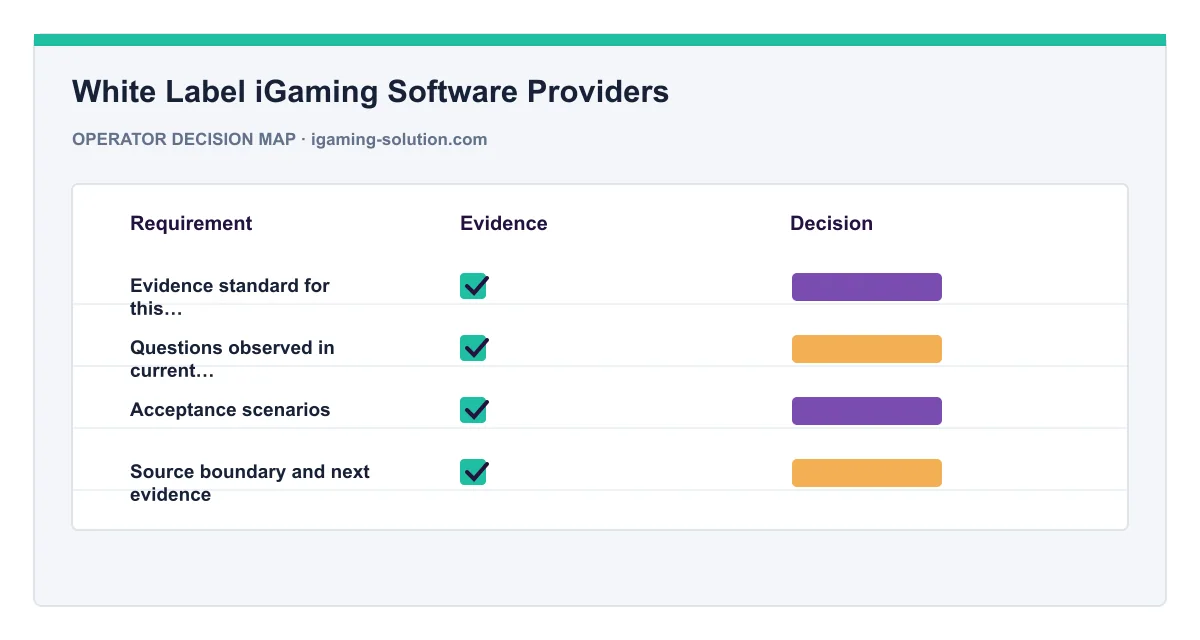
Evidence standard for this decision
Use Yes only when a current source or test explicitly supports the field; Partial when it supports only part of the scope; Not found when the reviewed public sources do not expose it; and Unknown when it has not yet been evaluated. Not found is not evidence that a capability is absent.
| Decision field | Evidence to request | Pass signal | Keep unresolved when |
|---|---|---|---|
| Comparison set | One buyer profile and explicit inclusion and exclusion rules | Candidates solve the same layer and operating problem | Platforms, modules, services, and content are mixed |
| Capability evidence | Current official documentation and buyer-owned workflow tests | Yes, Partial, Not found, and Unknown remain distinct | Feature count replaces evidence quality |
| Delivery fit | Responsibility, integration, staffing, market, and implementation map | Retained duties and dependencies are affordable and owned | Turnkey is interpreted as no operator work |
| Commercial and exit | Normalized TCO, SLA, data rights, transition, and remedies | The shortlist remains viable under a high case and an exit case | Only headline price and launch speed are compared |
Questions observed in current demand
Relevant Search Console demand includes igaming white label, white label gaming solutions, white label igaming software. The questions below convert that demand into a buyer-verification task.
What is igaming white label, who is it for, and what should a buyer verify?
There is no universal best option. Freeze the operator profile, jurisdiction, product boundary, delivery model, retained team, timeline, and risk tolerance; compare like-for-like evidence; and keep public unknowns unresolved until an RFP, demo, test, reference, or contract closes them. Apply that evidence rule specifically to White Label iGaming Software Providers and keep unverified product, price, market, and performance claims marked as unknown.
Question source: GSC query - igaming white label
What is white label gaming solutions, who is it for, and what should a buyer verify?
There is no universal best option. Freeze the operator profile, jurisdiction, product boundary, delivery model, retained team, timeline, and risk tolerance; compare like-for-like evidence; and keep public unknowns unresolved until an RFP, demo, test, reference, or contract closes them. Apply that evidence rule specifically to White Label iGaming Software Providers and keep unverified product, price, market, and performance claims marked as unknown.
Question source: GSC query - white label gaming solutions
What is white label igaming software, who is it for, and what should a buyer verify?
There is no universal best option. Freeze the operator profile, jurisdiction, product boundary, delivery model, retained team, timeline, and risk tolerance; compare like-for-like evidence; and keep public unknowns unresolved until an RFP, demo, test, reference, or contract closes them. Apply that evidence rule specifically to White Label iGaming Software Providers and keep unverified product, price, market, and performance claims marked as unknown.
Question source: GSC query - white label igaming software
Acceptance scenarios
- Score every candidate against the same evidence rule and preserve Not found instead of converting it to No.
- Run the same critical workflow and failure case in each shortlisted product or environment.
- Compare the base, high-volume, delayed-launch, and exit scenario before ranking suppliers.
Source boundary and next evidence
The linked study is the direct research source for this page's topic cluster. It publishes the sample or control set, field definitions, classifications, checked date, primary-source ledger, limitations, and downloadable data. It does not replace jurisdiction-specific legal advice, a supplier proposal, authenticated documentation, a production test, customer references, or a signed contract.
Read the provider platform research study or download its CSV dataset.
SERP-aligned buyer brief
Compare the operating contract, not only the front end
The current US results combine supplier landing pages, provider roundups, and educational guides. That mixed intent means a useful white-label page must explain the offer, identify current candidates, and make the retained operator responsibilities explicit.
| SERP candidate type | Examples surfaced for research | What to verify |
|---|---|---|
| Supplier offer | Gamingtec, OHS Gaming, Sirplay | Current product availability, included modules, launch markets, licences, PSPs, and named subcontractors |
| Platform-led alternative | Soft2Bet and other turnkey platform providers | Whether the proposal is white label, turnkey, or modular, and which entity owns each regulated duty |
| Educational or comparison source | SOFTSWISS knowledge base and independent provider roundups | Publication date, commercial relationships, scoring method, and whether claims are independently verified |
What to do next
- Ask for a responsibility matrix covering licence, KYC, AML, payments, player funds, complaints, responsible gambling, and reporting.
- Model setup fees, minimums, revenue share, PSP charges, content fees, support, and exit cost together.
- Require data export, domain and brand control, transition assistance, and termination economics in writing.
Search visibility is not evidence of product fit. Confirm each supplier's current offer and jurisdiction eligibility before shortlisting.
White label solutions occupy a distinct position within the iGaming technology landscape. Unlike casino- or sportsbook-specific platforms, white label iGaming software is defined primarily by its delivery and operational model rather than by product functionality.
White label iGaming software providers offer pre-configured platforms that allow operators to launch gambling brands without building or managing the full technical and regulatory stack themselves. This approach is often chosen to reduce time to market and operational complexity, particularly in regulated environments.
Understanding how white label providers operate — and where their responsibilities end — is essential for evaluating whether this model aligns with an operator’s long-term strategy.
What White Label iGaming Software Providers Actually Offer
White label iGaming software providers deliver a ready-to-operate platform that is branded and operated by the client but largely managed by the provider. This typically includes hosting, core platform functionality, integrations, and regulatory alignment.
In many cases, providers also handle ongoing maintenance, updates, and technical support. Operators focus primarily on branding, market positioning, and business management, while the provider retains control over the underlying technology.
Rather than supplying individual software components, white label providers deliver an operational framework designed to minimize technical involvement on the operator’s side.
“White label in iGaming is less about software ownership and more about responsibility allocation.”
Core Elements of White Label iGaming Platforms
Although offerings vary between providers, most white label iGaming platforms share a common structural foundation. The table below outlines the core elements typically included in a white label setup.
| Element | What it includes | Why it matters |
|---|---|---|
| Core platform | Player management, wallet logic, configuration | Forms the operational backbone |
| Content integrations | Games, betting content, providers | Enables immediate market offering |
| Compliance framework | KYC, AML, reporting, controls | Supports regulated market access |
| Hosting and infrastructure | Servers, uptime management, security | Reduces technical overhead |
| Back office access | Admin tools, reporting dashboards | Allows operational oversight |
| Ongoing maintenance | Updates, fixes, platform support | Ensures long-term stability |
Together, these elements allow operators to run a branded iGaming business without owning the full technology stack.
Types of White Label iGaming Providers
White label providers differ in how much control and flexibility they offer to operators.
The most common types include:
- fully managed white label providers with limited customization,
- semi-managed providers offering configurable modules,
- enterprise white label arrangements with dedicated environments.
Each type reflects a trade-off between speed, control, and operational independence.
How White Label Providers Differ From Platform Providers
White label providers are often confused with platform providers, but the distinction is significant.
Platform providers supply technology that operators integrate and operate themselves. White label providers, by contrast, operate the platform on behalf of the operator. This includes technical maintenance, compliance tooling, and often infrastructure management.
As a result, white label arrangements typically involve lower technical responsibility for the operator but also reduced control over platform behavior and future changes.
Who Uses White Label iGaming Software
White label iGaming software is primarily used by operators prioritizing speed and operational simplicity.
Typical users include:
- new brands entering regulated markets,
- media-driven or affiliate-backed gambling brands,
- operators testing new markets or concepts.
In these scenarios, white label platforms reduce upfront complexity but impose structural constraints.
What White Label Solutions Do Not Provide
Despite their comprehensive nature, white label solutions do not eliminate all operational responsibilities.
They do not remove the need for regulatory approval, even if compliance tooling is included. Licensing decisions remain jurisdiction-specific.
They do not guarantee marketing success or player acquisition. Brand positioning and growth strategy remain operator responsibilities.
They also do not offer full technological ownership. Platform changes, migrations, and deep customization are typically limited.
How White Label iGaming Software Is Delivered
White label software is delivered through predefined commercial and operational agreements.
Common delivery characteristics include:
- shared or dedicated platform instances,
- revenue-share or fixed-fee pricing models,
- long-term contracts with limited exit flexibility.
These factors should be evaluated carefully, as switching away from a white label platform can involve significant operational effort.
Why White Label Is a Strategic, Not Just Technical Choice
Choosing a white label solution affects more than technology. It shapes an operator’s control over compliance, scalability, and long-term differentiation.
While white label platforms enable rapid entry and reduced complexity, they may limit strategic flexibility as the business grows. For this reason, white label is best understood as a strategic operating model rather than a simple software shortcut.
Related White Label Topics
Related areas include iGaming software delivery models, operator responsibility frameworks, platform pricing structures, migration considerations, and comparisons between white label and modular platform approaches.
Concept map
Related concepts and decision guides
- sportsbook software public evidence 2026
- Compare the public procurement evidence disclosed by seven sportsbook technology offerings without treating marketing visibility as product quality.
- iGaming Casino Software Providers
- Online casinos rely on specialized software platforms to manage game content, player accounts, payments, and regulatory requirements.
- iGaming platforms
- The iGaming industry relies on a complex network of technology providers that operate largely behind the scenes.
- iGaming Software TCO Calculator
- Build a comparable planning scenario for supplier, retained-team, third-party, change, and exit costs without submitting data.
- iGaming Software Research
- Use reproducible public-evidence studies to turn vendor-market claims into testable procurement questions.
Evidence layer
Primary references and verification limits
Sources were checked on . They support the standards and verification questions used in this guide. They do not prove a supplier-specific price, market eligibility, implementation result, or private product claim; buyers should request current, versioned evidence for those points.
- iGaming Solution - provider platform research 2026 Original publisher research. A dated methodology, evidence matrix, primary-source ledger, limitations, and downloadable CSV supporting this page's decision framework.
- AWS Well-Architected — Reliability Pillar Cloud architecture guidance. Availability targets, resilience testing, incident learning, recovery objectives, capacity, and dependency management.
- NIST Cybersecurity Framework 2.0 Government standards body. Cybersecurity governance, risk management, protection, detection, response, and recovery outcomes.
- UK Gambling Commission — Remote gambling and software technical standards Regulator. Remote gambling software controls, security requirements, player-facing technical controls, and jurisdiction-specific verification questions.
- UK Gambling Commission — Testing strategy for remote gambling software Regulator. Testing, release control, audit evidence, change management, independent review, and production assurance questions.