


 Kody Nexov
 Published
Research-backed decision brief - checked 2026-07-24
Sportsbook Software Providers & Platforms: the decision-ready answer
There is no universal best option. Freeze the operator profile, jurisdiction, product boundary, delivery model, retained team, timeline, and risk tolerance; compare like-for-like evidence; and keep public unknowns unresolved until an RFP, demo, test, reference, or contract closes them.
The assigned US English query sportsbook software was checked on July 24, 2026. The result included AI Overview and People also ask, so concise answer structure and explicit source boundaries matter for both search and answer engines.
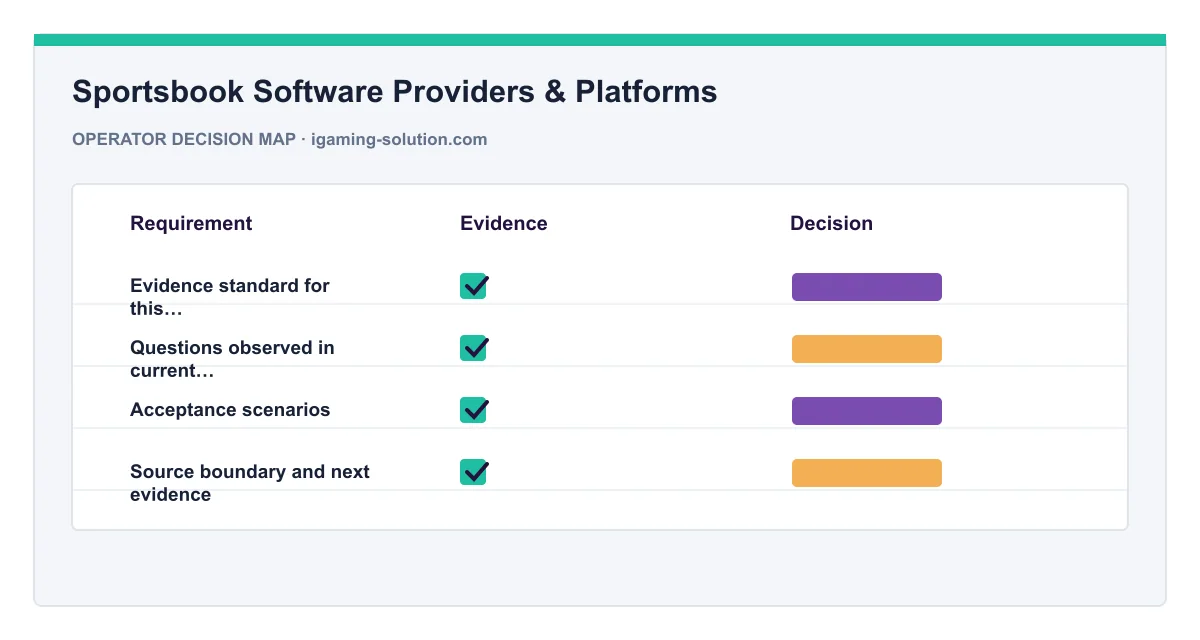
Evidence standard for this decision
Use Yes only when a current source or test explicitly supports the field; Partial when it supports only part of the scope; Not found when the reviewed public sources do not expose it; and Unknown when it has not yet been evaluated. Not found is not evidence that a capability is absent.
| Decision field | Evidence to request | Pass signal | Keep unresolved when |
|---|---|---|---|
| Comparison set | One buyer profile and explicit inclusion and exclusion rules | Candidates solve the same layer and operating problem | Platforms, modules, services, and content are mixed |
| Capability evidence | Current official documentation and buyer-owned workflow tests | Yes, Partial, Not found, and Unknown remain distinct | Feature count replaces evidence quality |
| Delivery fit | Responsibility, integration, staffing, market, and implementation map | Retained duties and dependencies are affordable and owned | Turnkey is interpreted as no operator work |
| Commercial and exit | Normalized TCO, SLA, data rights, transition, and remedies | The shortlist remains viable under a high case and an exit case | Only headline price and launch speed are compared |
Questions observed in current demand
Relevant Search Console demand includes sportsbook software, sportsbook solution, sportsbook software provider. The questions below convert that demand into a buyer-verification task.
What is sportsbook software, who is it for, and what should a buyer verify?
There is no universal best option. Freeze the operator profile, jurisdiction, product boundary, delivery model, retained team, timeline, and risk tolerance; compare like-for-like evidence; and keep public unknowns unresolved until an RFP, demo, test, reference, or contract closes them. Apply that evidence rule specifically to Sportsbook Software Providers & Platforms and keep unverified product, price, market, and performance claims marked as unknown.
Question source: GSC query - sportsbook software
What is sportsbook solution, who is it for, and what should a buyer verify?
There is no universal best option. Freeze the operator profile, jurisdiction, product boundary, delivery model, retained team, timeline, and risk tolerance; compare like-for-like evidence; and keep public unknowns unresolved until an RFP, demo, test, reference, or contract closes them. Apply that evidence rule specifically to Sportsbook Software Providers & Platforms and keep unverified product, price, market, and performance claims marked as unknown.
Question source: GSC query - sportsbook solution
Which sportsbook software provider fit different operator requirements, and how can buyers verify their claims?
Answer it for a defined operator profile. Compare only like-for-like options, apply one evidence rule, and leave supplier-specific unknowns open until they are closed by current documentation, testing, references, or contract terms.
Question source: GSC query - sportsbook software provider
Acceptance scenarios
- Score every candidate against the same evidence rule and preserve Not found instead of converting it to No.
- Run the same critical workflow and failure case in each shortlisted product or environment.
- Compare the base, high-volume, delayed-launch, and exit scenario before ranking suppliers.
Source boundary and next evidence
The linked study is the direct research source for this page's topic cluster. It publishes the sample or control set, field definitions, classifications, checked date, primary-source ledger, limitations, and downloadable data. It does not replace jurisdiction-specific legal advice, a supplier proposal, authenticated documentation, a production test, customer references, or a signed contract.
Read the sportsbook research study or download its CSV dataset.
SERP-aligned buyer brief
Operator sportsbook software, not bettor tools
For this guide, sportsbook software means B2B infrastructure used to run a betting operation. It does not mean a consumer odds-comparison app, a betting calculator, or a personal analytics tool. Current US results mix provider landing pages with ranked provider comparisons, so buyers need both a market map and a verification framework.
| Solution layer | Examples to investigate | Evidence to request |
|---|---|---|
| Enterprise sportsbook core | OpenBet, Kambi, Playtech | Comparable operator references, market coverage, peak-event capacity, and migration evidence |
| Modular or turnkey sportsbook | EveryMatrix OddsMatrix, BetConstruct, Altenar | Trading model, wallet integration, back-office depth, launch dependencies, and commercial exclusions |
| Managed or fast-launch offer | Gamingtec and other managed sportsbook offers | Exact division of trading, risk, support, compliance, and incident responsibilities |
| Odds and data layer | LSports, Sportradar, Genius Sports | Rights by market, end-to-end latency, settlement policy, correction SLA, and fallback feeds |
What to do next
- Shortlist by operating model and jurisdiction before comparing feature counts.
- Price platform, feeds, managed trading, payment dependencies, and internal operations on one basis.
- Run the same peak-event, suspension, bet-settlement, rollback, and reconciliation scenarios with every candidate.
- Use the public-evidence study to separate documented supplier scope from fields that still require an RFP, demo, test, or contract.
Five acceptance scenarios every sportsbook should pass
Feature lists do not expose operational failure modes. Run the same scenario pack with each shortlisted product and record the evidence, owner, and unresolved exceptions.
| Scenario | What to demonstrate | Pass evidence |
|---|---|---|
| Peak event | Price updates, bet placement, limits, cash-out, settlement, and back-office response under agreed load | Load profile, latency and error results, dashboards, capacity owner, and degradation rules |
| Market suspension | Suspend and reopen correlated markets across channels without accepting stale prices | State-transition log, trader controls, player messaging, and audit trail |
| Feed degradation | Detect delayed or conflicting data and move to a controlled fallback | Thresholds, source priority, alert route, manual override, and incident record |
| Settlement correction | Reverse and re-settle affected bets without corrupting balances or reporting | Idempotent workflow, wallet ledger entries, customer-impact report, and reconciliation |
| Wallet retry | Handle timeout, duplicate, and out-of-order transaction messages | Request identifiers, retry policy, duplicate prevention, exception queue, and end-of-day reconciliation |
The companies above are examples for investigation, not a ranking or an endorsement. Product scope and market availability must be verified directly with each supplier.
Sportsbook operations rely on a distinct class of technology that differs fundamentally from casino-focused platforms. While both fall under the broader iGaming umbrella, sportsbook software is built around real-time data processing, risk management, and event-driven logic rather than game content aggregation.
Sportsbook software providers develop platforms that support betting markets, odds calculation, wager acceptance, settlement, and exposure control. These platforms operate under strict performance and reliability requirements, as delays or inconsistencies can directly affect financial outcomes and regulatory compliance.
Understanding how sportsbook platforms are structured — and what sportsbook software providers are responsible for — is essential when evaluating betting-focused technology independently of other iGaming verticals.
What Sportsbook Software Providers Actually Deliver
Sportsbook software providers supply the core systems required to run online and omnichannel betting operations. Their platforms manage the full betting lifecycle, from market creation and odds updates to bet settlement and reporting.
In many cases, providers also integrate official data feeds, manage risk controls, and support regulatory reporting specific to sports betting markets. Unlike casino platforms, sportsbook systems must process large volumes of time-sensitive data with minimal latency.
Rather than delivering isolated tools, sportsbook providers offer tightly integrated platforms designed to operate continuously during live events.
“In sportsbook operations, latency and risk control are as critical as feature breadth.”
Core Technology in Sportsbook Platforms
Although sportsbook platforms vary in sophistication, most share a common technological foundation. The table below outlines the core components typically delivered by sportsbook software providers.
| Component | What it covers | Why it matters |
|---|---|---|
| Sportsbook core engine | Market management, bet placement, settlement logic | Central to betting operations |
| Odds and pricing | Odds calculation, margin control, market updates | Determines profitability and competitiveness |
| Risk management | Exposure limits, liability control, alerts | Protects against financial risk |
| Data feeds | Sports data and event updates | Powers real-time betting markets |
| Player accounts | Balances, betting history, limits | Supports regulated betting |
| Reporting and back office | Operational dashboards, regulatory reports | Enables oversight and compliance |
Together, these components form the operational backbone of a sportsbook platform.
Types of Sportsbook Software Providers
Sportsbook providers operate under different models depending on their target operators and market focus.
The most common provider types include:
- full-service sportsbook platform providers with integrated risk and data,
- modular sportsbook providers offering selected components,
- platform providers focused on managed or outsourced sportsbook operations.
Each model reflects a different balance between control, operational responsibility, and speed to market.
How Sportsbook Platforms Differ From Casino Platforms
While casino platforms focus on content delivery and engagement mechanics, sportsbook platforms are optimized for event-driven logic and financial risk control.
Sportsbook systems must handle frequent odds changes, live betting scenarios, and exposure management across thousands of concurrent events. Casino platforms, by contrast, operate with more predictable content and session logic.
Because of these differences, sportsbook software providers typically specialize in betting-centric architectures rather than adapting casino platforms for wagering.
Who Uses Sportsbook Software Platforms
Sportsbook software providers primarily serve operators running betting-focused brands.
Typical clients include:
- licensed sportsbook operators,
- land-based bookmakers expanding online,
- media and data-driven betting brands.
In each case, sportsbook platforms support betting operations rather than casino or hybrid gaming models.
What Sportsbook Software Providers Do Not Provide
Despite their central role, sportsbook software providers do not control every aspect of a betting business.
They do not issue betting licenses or guarantee regulatory approval. Licensing remains the responsibility of operators and regulators.
They do not manage marketing or player acquisition. While platforms may integrate with CRM systems, growth strategy lies outside the software scope.
They also do not remove operational risk entirely. Risk management tools support decision-making, but human oversight remains essential.
How Sportsbook Platforms Are Typically Delivered
Sportsbook software is delivered through different commercial and operational models.
Common delivery approaches include:
- managed sportsbook platforms with shared infrastructure,
- dedicated sportsbook instances for larger operators,
- hybrid models combining managed services with operator control.
Each approach affects latency, scalability, and risk ownership.
Why Sportsbook Software Providers Matter in Regulated Betting Markets
Sports betting markets are highly regulated and sensitive to operational failures. Platform stability, data integrity, and auditability are critical for maintaining regulatory approval and player trust.
Because platform changes can directly impact betting integrity, sportsbook software providers are evaluated on reliability, data partnerships, and operational maturity rather than feature volume alone.
For operators, sportsbook platforms represent a core operational dependency rather than a replaceable technology layer.
Related Sportsbook Technology Topics
Related areas include sports data providers, odds management systems, risk and trading tools, betting compliance frameworks, and comparisons between managed and self-operated sportsbook platforms.
Concept map
Related concepts and decision guides
- iGaming Software Solutions for Operators comparison
- Choosing iGaming software is rarely about features alone.
- Sportsbook Software Buying Library guide
- Follow a technical and commercial learning path from platform basics to live betting, controls, mobile delivery, and back-office operations.
- Sportsbook Risk Management Software
- Assess exposure controls, limits, alerts, and managed-trading boundaries.
- Sports Betting Platform Providers comparison
- Compare provider operating models and shortlist platforms against your betting product.
- Sportsbook Odds Feed Providers technical guide
- Compare feed coverage, latency, rights, settlement quality, and integration terms.
Evidence layer
Primary references and verification limits
Sources were checked on . They support the standards and verification questions used in this guide. They do not prove a supplier-specific price, market eligibility, implementation result, or private product claim; buyers should request current, versioned evidence for those points.
- iGaming Solution - Sportsbook Software Public-Evidence Study 2026 Original publisher research. A dated, reproducible comparison of public API, trading, technical-documentation, pricing, SLA, trial, and migration evidence across seven sportsbook technology offerings.
- iGaming Solution - sportsbook research 2026 Original publisher research. A dated methodology, evidence matrix, primary-source ledger, limitations, and downloadable CSV supporting this page's decision framework.
- AWS Well-Architected — Reliability Pillar Cloud architecture guidance. Availability targets, resilience testing, incident learning, recovery objectives, capacity, and dependency management.
- NIST Cybersecurity Framework 2.0 Government standards body. Cybersecurity governance, risk management, protection, detection, response, and recovery outcomes.
- UK Gambling Commission — Remote gambling and software technical standards Regulator. Remote gambling software controls, security requirements, player-facing technical controls, and jurisdiction-specific verification questions.
- UK Gambling Commission — Testing strategy for remote gambling software Regulator. Testing, release control, audit evidence, change management, independent review, and production assurance questions.