


 Kody Nexov
 Published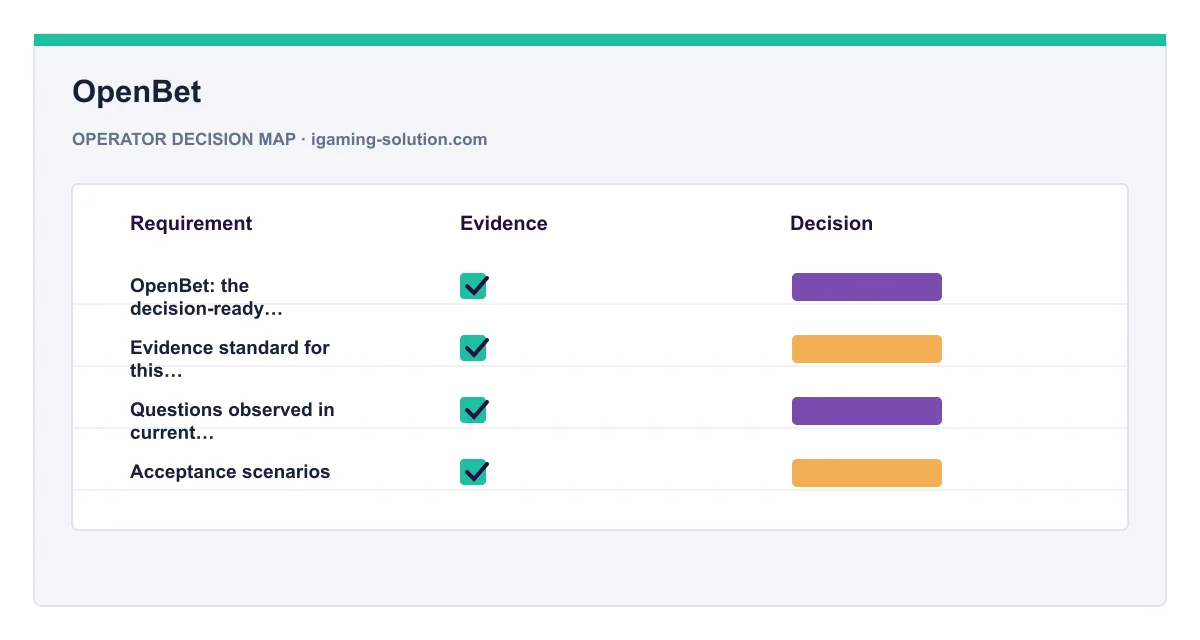
Research-backed decision brief - checked 2026-07-24
OpenBet: the decision-ready answer
A defensible vendor conclusion needs a named product version, deployment model, jurisdiction, responsibility boundary, integration evidence, commercial schedule, service commitment, and exit plan. A supplier page can establish a public claim, but it cannot establish contractual fit or production performance.
The assigned US English query OpenBet was checked on July 24, 2026. The result included People also ask, so concise answer structure and explicit source boundaries matter for both search and answer engines.
Evidence standard for this decision
Use Yes only when a current source or test explicitly supports the field; Partial when it supports only part of the scope; Not found when the reviewed public sources do not expose it; and Unknown when it has not yet been evaluated. Not found is not evidence that a capability is absent.
| Decision field | Evidence to request | Pass signal | Keep unresolved when |
|---|---|---|---|
| Product boundary | Versioned module and third-party responsibility map | Included, optional, partner-supplied, and retained duties are explicit | A broad product list is treated as complete scope |
| Technical fit | Current API docs, sandbox, limits, error model, and deprecation policy | Critical workflows pass buyer-owned tests | Integration is inferred from an API marketing claim |
| Commercial fit | Comparable setup, fixed, usage, minimum, support, and exit charges | A base and high-volume TCO can be reproduced | Headline price or revenue share is the only figure |
| Service and exit | Measured SLA, incident duties, export format, and transition assistance | Remedies and replacement path are contractually testable | Support and migration are described only as available |
Questions observed in current demand
Relevant Search Console demand includes openbet casino withdrawal, openbet slots, openbet withdrawal. The questions below convert that demand into a buyer-verification task.
What is openbet casino withdrawal, who is it for, and what should a buyer verify?
A defensible vendor conclusion needs a named product version, deployment model, jurisdiction, responsibility boundary, integration evidence, commercial schedule, service commitment, and exit plan. A supplier page can establish a public claim, but it cannot establish contractual fit or production performance. Apply that evidence rule specifically to OpenBet and keep unverified product, price, market, and performance claims marked as unknown.
Question source: GSC query - openbet casino withdrawal
What is openbet slots, who is it for, and what should a buyer verify?
A defensible vendor conclusion needs a named product version, deployment model, jurisdiction, responsibility boundary, integration evidence, commercial schedule, service commitment, and exit plan. A supplier page can establish a public claim, but it cannot establish contractual fit or production performance. Apply that evidence rule specifically to OpenBet and keep unverified product, price, market, and performance claims marked as unknown.
Question source: GSC query - openbet slots
What is openbet withdrawal, who is it for, and what should a buyer verify?
A defensible vendor conclusion needs a named product version, deployment model, jurisdiction, responsibility boundary, integration evidence, commercial schedule, service commitment, and exit plan. A supplier page can establish a public claim, but it cannot establish contractual fit or production performance. Apply that evidence rule specifically to OpenBet and keep unverified product, price, market, and performance claims marked as unknown.
Question source: GSC query - openbet withdrawal
Acceptance scenarios
- Run one revenue-critical workflow end to end using the proposed product version and production-like data.
- Inject a dependency failure and verify retries, operator visibility, reconciliation, escalation, and recovery evidence.
- Request a full bulk export and a termination runbook before approving the commercial term.
Source boundary and next evidence
The linked study is the direct research source for this page's topic cluster. It publishes the sample or control set, field definitions, classifications, checked date, primary-source ledger, limitations, and downloadable data. It does not replace jurisdiction-specific legal advice, a supplier proposal, authenticated documentation, a production test, customer references, or a signed contract.
Read the provider platform research study or download its CSV dataset.
iGaming Platform Vendor Overview
This page is written for operators, product leaders and technical teams evaluating OpenBet.
It focuses on modules, integration reality, procurement questions and verifiable references — not marketing claims.
- What you get: module breakdown, integration map, RFP checklist
- Best for: regulated-market operators, sportsbook-led programs, complex operations
- How to use: shortlist fit → validate integrations → verify references → run an RFP
Verification approach: we separate “vendor claims” from “publicly verifiable statements”.
If something is not verifiable, we label it as such.
Quick summary
What is OpenBet?
OpenBet is a sportsbook platform vendor typically positioned for operators that need a robust,
regulated-market-ready stack: sportsbook engine, trading/management options, player protection tooling,
and a broader platform layer for integrations and operations.
Best fit (typical)
- Regulated-market operators with strict compliance needs
- Sportsbook-led brands where trading and risk management matter
- Teams that can run a structured integration + RFP process
- Operators needing player protection / RG tooling as part of the stack
Not ideal if
- You want a “fastest-to-launch” low-complexity, low-custom stack
- You have minimal integration resources and no systems ownership
- You need a casino-first platform and sportsbook is secondary
- Your procurement requires fixed, simple pricing with limited scope variance
Operator takeaway: Treat OpenBet as a “systems program”, not a plug-in.
The evaluation should focus on (1) integration responsibilities, (2) operational tooling maturity,
(3) regulated-market requirements, and (4) public references relevant to your jurisdiction and model.
Modules (what each one does)
Naming varies by release and go-to-market positioning. Use the breakdown below as a practical “what it solves + what it touches”
mapping for operators.
Bet: sportsbook core
What it solves: core sportsbook capability: event/market offering, bet placement, settlement, account/bet lifecycle.
- Usually integrates with: player account / wallet, identity, payments, geo, risk/limits, reporting, customer support.
- Procurement questions:
- Which components are “OpenBet-owned” vs operator-owned (wallet, PAM, CMS, payments, geo)?
- Where are limits and responsible gaming controls enforced: platform, wallet, or both?
- How are outages handled operationally (manual settlement, risk holds, incident comms)?
Trade: trading & risk operations (managed vs operator-led)
What it solves: the operational layer for odds, risk management, margin control and trading workflows.
- Usually integrates with: data feeds, pricing sources, internal risk tools, operator dashboards, reporting/BI.
- Procurement questions:
- Is trading provided as a managed service, a toolset, or both?
- What are the escalation paths (market suspensions, suspicious betting, integrity events)?
- How do you validate margin/hold performance and operational SLAs?
Transform: platform operations & tooling
What it solves: operational enablement — configuration, promotions, reporting surfaces, orchestration and platform tooling
that makes a sportsbook program manageable.
- Usually integrates with: CRM, bonus engine, CMS, analytics, BI, customer support tooling, identity/permissions.
- Procurement questions:
- Which operator workflows are supported out-of-the-box (promos, segmentation, reporting, customer ops)?
- What is configurable vs requires professional services?
- How do releases impact configuration and custom work?
Protect: player protection / RG / compliance tooling
What it solves: monitoring and controls for responsible gaming, risk flags, compliance workflows.
- Usually integrates with: player profile, wallet, KYC/AML services, geo, reporting, case management.
- Procurement questions:
- Which RG features are enforced at transaction time vs after-the-fact monitoring?
- How are jurisdictions handled (rules, reporting, thresholds)?
- What evidence can be provided for audits (exports, logs, change history)?
Neccton (if included): monitoring & analytics for protection
What it solves: dedicated monitoring layer used by operators for responsible gaming and compliance-related detection workflows.
Treat it as a distinct system with its own data needs and governance requirements.
- Usually integrates with: event/bet data, player data, AML/KYC signals, case management workflows.
- Procurement questions:
- What data fields are required for effective detection (and who owns data quality)?
- How are false positives handled and tuned over time?
- What is the operator’s governance model (who reviews cases, what is logged)?
Integration map (what to connect)
Operators often underestimate scope by treating the platform as a single system. Use the map below to define responsibilities early.
| Component | Typical owner | Integration type | Common risks | What to verify |
|---|---|---|---|---|
| Player account / PAM | Vendor / Operator (varies) | APIs + identity/permissions | Account state mismatches, roles/permissions | Who is source of truth for player status & restrictions |
| Wallet & transactions | Operator / Vendor (varies) | APIs + ledger rules | Reconciliation, refunds/voids, partial settlements | Ledger ownership, audit trails, dispute flows |
| KYC / AML | Operator | 3rd-party services + rules engine | Jurisdiction rules drift, manual review load | Enforcement points (before bet? before withdrawal?) |
| Payments | Operator | PSP integrations | Chargebacks, fraud vectors, payout SLAs | Failure handling, monitoring, reconciliation cadence |
| Geolocation | Operator / Vendor partner | SDK/API + policy rules | False blocks/false passes, latency | Jurisdiction policy coverage, audit logs |
| Trading / data feeds | Vendor / Operator (varies) | Feed ingestion + controls | Feed outages, integrity incidents | Fallback plans, suspension workflows, SLAs |
| CRM / promotions | Operator | Events + segmentation | Bonus abuse, inconsistent eligibility | Eligibility enforcement location, reporting |
| Analytics / BI | Operator | Event streams + exports | Data gaps, attribution issues | Data dictionary, export cadence, change control |
| Support tooling | Operator | Case workflows + player views | Limited visibility into bet lifecycle | Support views, permissions, auditability |
Tip: In your RFP, require a one-page “Responsibility Matrix” (RACI) for each component above.
Most delays happen when ownership is unclear.
RFP / procurement checklist (practical)
Minimal operator checklist (copy/paste)
- Scope clarity: define what is included (sportsbook core, trading, RG tooling, platform operations) and what is not (PAM, wallet, payments, geo).
- Integration ownership: require a RACI + data dictionary + event taxonomy.
- Regulated-market readiness: list jurisdictions, reporting obligations, audit requirements, and enforcement points.
- SLAs & incident ops: uptime, incident communications, runbooks, escalation paths, post-mortems.
- Security & governance: access controls, change control, logs, retention, export capability.
- Migration plan: player data, open bets, reporting continuity, cutover rehearsal.
- Total cost drivers: integration complexity, customization, support model, release cadence impact, managed trading scope.
Questions for product & ops
- What operator workflows are supported without services (promos, reporting, settlement exceptions)?
- How are risk flags and RG interventions operationally handled?
- What is the standard release cadence and how are breaking changes communicated?
Questions for engineering
- API coverage: account lifecycle, bet lifecycle, settlement, limits, exports — what’s truly available?
- Data: event streams vs batch exports; fields and SLAs; versioning and change management.
- Monitoring: what telemetry is provided, and what the operator must build.
Compliance & Responsible Gaming (RG)
For regulated markets, “RG/Compliance ready” should be validated as implementation detail:
enforcement points, logs, exports, and jurisdiction policies — not just feature lists.
What to validate
- Enforcement: when and where restrictions apply (pre-bet, pre-withdrawal, account state).
- Auditability: immutable logs, change history, role-based access, export capability.
- Jurisdiction policies: thresholds, reporting formats, retention, local rule configuration.
- Case workflows: review queues, escalations, operator actions and outcomes.
Operator risk flags
- RG tooling exists but is not operationalized (no staffing / no runbooks).
- Data quality gaps reduce detection accuracy and raise audit risk.
- Ownership split (wallet vs platform) causes enforcement inconsistencies.
Commercial model: what drives pricing (in practice)
Vendors rarely publish pricing publicly. Instead of chasing numbers, define the drivers of total cost:
- Scope: modules included (sportsbook, trading, operations, protection tooling).
- Ownership model: whether PAM/wallet/geo/payments are included or operator-owned.
- Managed services: managed trading, support coverage windows, incident response model.
- Customization: configuration vs professional services; bespoke workflows; reporting requirements.
- Jurisdictions: compliance obligations, certifications, reporting and audit depth.
- Data: exports, streaming, retention, and data governance requirements.
Procurement note: ask the vendor for a “costed scope matrix” where each module and service line is priced,
and integration responsibilities are explicit.
Verified public references
Below are examples of publicly referenced operator/partner relationships. Always validate relevance by jurisdiction, time period, and scope.
-
Veikkaus (Finland): public partnership announcements referencing OpenBet in the operator stack.
Validate scope and current status via official releases. -
Danske Spil (Denmark): public references to OpenBet collaboration over time.
Validate module scope and contract evolution via official releases. -
WestLotto (Germany): public references connected to player protection / monitoring tooling (e.g., via Neccton where applicable).
Validate jurisdiction requirements and operational deployment via official releases. -
Fanatics (US): public references to player protection / geolocation / compliance-related tooling in a sportsbook context.
Validate which components are OpenBet-provided vs partner-provided.
How to use references: ask for a call with an operator in a similar regulatory environment,
and request a “what we wish we knew before integration” debrief.
Alternatives & decision tree
When OpenBet is a strong choice
- You need a sportsbook-led stack built for regulated-market operations
- You value trading/risk tooling maturity and operational governance
- You can invest in integration, data governance and long-term platform operations
When you should shortlist alternatives
- You need a simplified “fast launch” platform with minimal integrations
- Your primary business is casino-first and sportsbook is secondary
- You need extreme flexibility with a strong in-house engineering program (build-heavy path)
Decision tree (quick)
- Are you regulated-market heavy? If yes → prioritize compliance evidence, auditability and jurisdiction tooling.
- Do you need managed trading? If yes → evaluate “service + tooling + SLA” as one package.
- Who owns wallet/PAM? If operator-owned → integration complexity increases; verify RACI early.
- Do you need player protection stack depth? If yes → evaluate monitoring, workflows, exports and staffing model.
- Is speed-to-market #1? If yes → compare against simplified stacks; validate tradeoffs.
FAQ
Is OpenBet sportsbook-only or multi-vertical?
OpenBet is best known for sportsbook platform capabilities. In procurement, clarify whether your program requires casino-first capabilities
and whether those are in-scope via OpenBet, partners, or separate systems.
What typically causes delays in implementation?
Most delays come from unclear ownership (wallet/PAM/payments/geo), data governance gaps, and underestimated operational workflows
(settlement exceptions, fraud/risk, RG case handling).
How should we evaluate “responsible gaming” claims?
Ask for enforcement details (when restrictions apply), audit logs, export formats, change control, and an operational workflow walkthrough
with real roles (who reviews cases, how actions are logged, and how outcomes are reported).
Do we need in-house engineering to run this platform?
Even with vendor support, operators usually need integration ownership: monitoring, data pipelines, incident processes, and governance.
If engineering resources are limited, prioritize clarity on managed services and operator responsibilities.
What should be included in the RFP to avoid surprises?
Require a RACI matrix for all core components, a data dictionary, release/change management process, incident runbooks,
and a costed scope matrix by module and service line.
Sources & update log
Primary sources (recommended)
- Official vendor pages and product documentation (OpenBet)
- Official operator press releases (e.g., Veikkaus, Danske Spil, WestLotto, Fanatics)
- Regulator publications relevant to your target jurisdictions
Update log
- 2026-01-15: Page rewritten to be operator-focused: module breakdown, integration map, procurement checklist, and verification framing.
Disclaimer: This overview is informational and should not be treated as legal advice. Always validate compliance and licensing requirements
with your legal/regulatory advisors and confirm vendor scope in your contract.
Concept map
Related concepts and decision guides
- iGaming Provider Reviews
- Build a defensible vendor shortlist from comparable provider evidence.
- sportsbook software public evidence 2026
- Compare the public procurement evidence disclosed by seven sportsbook technology offerings without treating marketing visibility as product quality.
- SOFTSWISS product profile
- This page is built for operators, product leaders, and implementation teams evaluating SOFTSWISS.
- BetConstruct product profile
- BetConstruct markets a wide product portfolio for online and land-based betting & gaming, including sportsbook, casino platform and turnkey/white-label options.
- Playtech casino software
- Playtech describes its offering as a product suite that integrates with existing technology and includes a player management platform (PAM+/IMS) plus casino, live, sports and re...
Evidence layer
Primary references and verification limits
Sources were checked on . They support the standards and verification questions used in this guide. They do not prove a supplier-specific price, market eligibility, implementation result, or private product claim; buyers should request current, versioned evidence for those points.
- iGaming Solution - provider platform research 2026 Original publisher research. A dated methodology, evidence matrix, primary-source ledger, limitations, and downloadable CSV supporting this page's decision framework.
- UK Gambling Commission — Remote gambling and software technical standards Regulator. Remote gambling software controls, security requirements, player-facing technical controls, and jurisdiction-specific verification questions.
- UK Gambling Commission — Testing strategy for remote gambling software Regulator. Testing, release control, audit evidence, change management, independent review, and production assurance questions.
- OpenBet — official product information Supplier. Current supplier-published product scope; it does not independently verify performance, pricing, eligibility, or operator outcomes.