


 Kody Nexov
 Published
Research-backed decision brief - checked 2026-07-24
iGaming API Providers & Integrations: the decision-ready answer
Start with the system boundary and data flow, then verify interfaces, identity, versioning, latency, capacity, failure handling, reconciliation, observability, recovery, and ownership. A component name or architecture diagram is not implementation evidence.
The assigned US English query igaming API providers was checked on July 24, 2026. The result pattern was used to validate the page intent and question set.
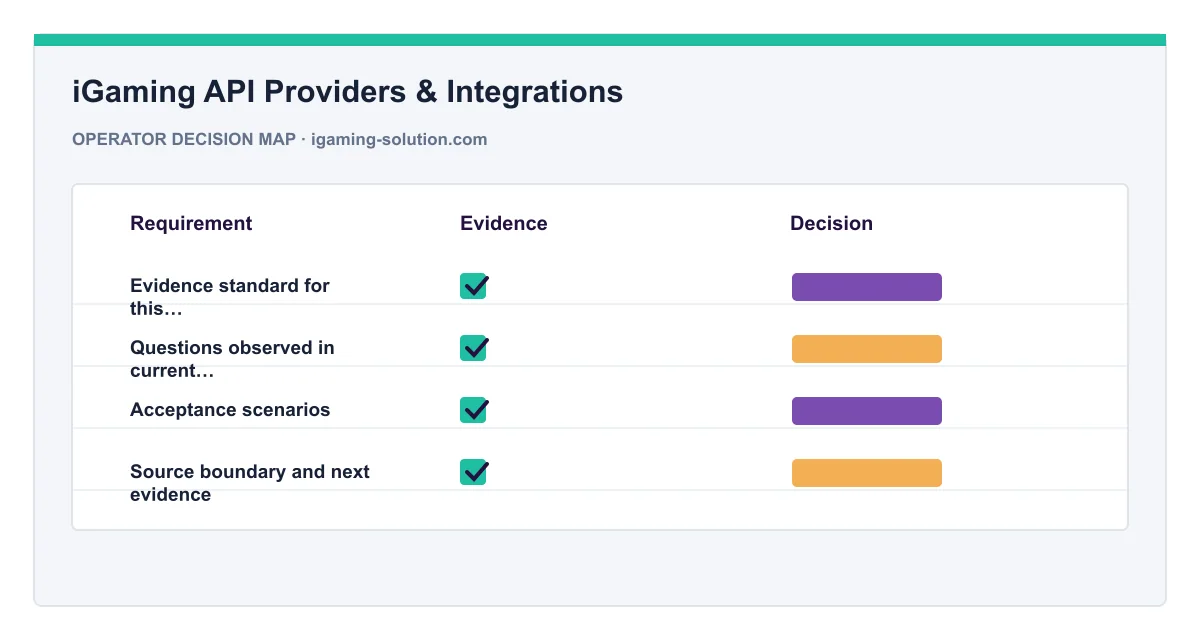
Evidence standard for this decision
Use Yes only when a current source or test explicitly supports the field; Partial when it supports only part of the scope; Not found when the reviewed public sources do not expose it; and Unknown when it has not yet been evaluated. Not found is not evidence that a capability is absent.
| Decision field | Evidence to request | Pass signal | Keep unresolved when |
|---|---|---|---|
| Boundary and data | Component, trust-boundary, event, and system-of-record map | Source, destination, owner, retention, and reconciliation are explicit | The diagram omits failure and ownership |
| Interface contract | Versioned schema, auth, limits, idempotency, errors, and deprecation | Consumer tests run against a representative sandbox | Only endpoint names or an integration claim are public |
| Reliability | SLOs, dependency budgets, capacity tests, recovery objectives, and drills | Targets have a measurement source and failure response | Scalable or highly available is the only claim |
| Security and operations | Access, audit, secrets, vulnerability, change, incident, and export evidence | Controls are testable and owned across parties | A certificate replaces workflow evidence |
Questions observed in current demand
Relevant Search Console demand includes online igaming api, igaming api, igaming payment gateway integration services. The questions below convert that demand into a buyer-verification task.
What is online igaming api, who is it for, and what should a buyer verify?
Start with the system boundary and data flow, then verify interfaces, identity, versioning, latency, capacity, failure handling, reconciliation, observability, recovery, and ownership. A component name or architecture diagram is not implementation evidence. Apply that evidence rule specifically to iGaming API Providers & Integrations and keep unverified product, price, market, and performance claims marked as unknown.
Question source: GSC query - online igaming api
What is igaming api, who is it for, and what should a buyer verify?
Start with the system boundary and data flow, then verify interfaces, identity, versioning, latency, capacity, failure handling, reconciliation, observability, recovery, and ownership. A component name or architecture diagram is not implementation evidence. Apply that evidence rule specifically to iGaming API Providers & Integrations and keep unverified product, price, market, and performance claims marked as unknown.
Question source: GSC query - igaming api
What is igaming payment gateway integration services, who is it for, and what should a buyer verify?
Start with the system boundary and data flow, then verify interfaces, identity, versioning, latency, capacity, failure handling, reconciliation, observability, recovery, and ownership. A component name or architecture diagram is not implementation evidence. Apply that evidence rule specifically to iGaming API Providers & Integrations and keep unverified product, price, market, and performance claims marked as unknown.
Question source: GSC query - igaming payment gateway integration services
Acceptance scenarios
- Replay duplicate, delayed, out-of-order, and partially failed requests and reconcile the final state.
- Load-test the peak business event with the same dependency limits and observability used in production.
- Revoke a privileged user, rotate a secret, restore a service, and export the resulting audit record.
Source boundary and next evidence
The linked study is the direct research source for this page's topic cluster. It publishes the sample or control set, field definitions, classifications, checked date, primary-source ledger, limitations, and downloadable data. It does not replace jurisdiction-specific legal advice, a supplier proposal, authenticated documentation, a production test, customer references, or a signed contract.
Read the provider platform research study or download its CSV dataset.
Modern iGaming platforms rarely operate as closed systems. Instead, they rely on a network of external services connected through application programming interfaces, or APIs. These integrations allow platforms to combine game content, payment processing, compliance tooling, and operational services into a single working environment.
iGaming API providers play a critical role in this architecture. They enable platforms to communicate with third-party systems in a controlled and scalable way, without embedding all functionality directly into the core platform. For operators, APIs are not optional enhancements, but a foundational layer of platform flexibility.
Understanding how iGaming APIs work — and what role API providers play — is essential for evaluating platform capabilities beyond surface-level features.
What iGaming API Providers Actually Do
iGaming API providers develop and maintain standardized interfaces that allow platforms to connect with external services. These interfaces define how data is exchanged, how actions are triggered, and how systems remain synchronized in real time.
In practice, API providers abstract technical complexity. Instead of building custom connections for every service, platforms rely on APIs to integrate games, payment providers, identity verification tools, analytics systems, and other operational components.
From an operational standpoint, APIs act as the connective tissue of the iGaming ecosystem, enabling modular growth without constant redevelopment of the core platform.
“In iGaming, APIs determine how fast a platform can adapt without rewriting its foundation.”
Core API Integration Areas in iGaming
While API implementations differ by provider, most iGaming platforms rely on a similar set of integration categories. The table below outlines the most common API areas and their operational role.
| API category | What it connects | Why it matters |
|---|---|---|
| Game APIs | Game studios and aggregators | Enables scalable content distribution |
| Payment APIs | PSPs, wallets, banking services | Manages deposits, withdrawals, and transaction flows |
| Identity & KYC APIs | Verification and AML services | Supports regulatory compliance |
| Risk & fraud APIs | Monitoring and risk-scoring tools | Protects platforms from abuse and fraud |
| CRM & analytics APIs | Marketing and data platforms | Enables reporting and lifecycle tracking |
| Platform APIs | Internal and external system access | Allows customization and extensions |
These APIs operate continuously, often handling thousands of requests per second in live environments.
Types of iGaming API Providers
Not all API providers serve the same purpose within an iGaming platform. Their role depends on the level of abstraction and responsibility they assume.
The most common types include:
- specialized API providers focused on a single function, such as payments or verification,
- aggregation APIs that unify access to multiple third-party services,
- platform-native APIs exposed by iGaming platforms themselves.
Each type influences integration effort, flexibility, and long-term maintainability.
APIs vs Direct Integrations
Some operators assume that direct integrations offer greater control than APIs. In practice, the opposite is often true.
Direct integrations tend to be tightly coupled, making updates and replacements more complex. API-based integrations, by contrast, introduce a defined contract between systems. This contract allows changes on one side without breaking the entire platform.
For this reason, mature iGaming platforms increasingly rely on API-first architectures rather than bespoke point-to-point connections.
Who Relies on iGaming API Integrations
API integrations are used by a wide range of stakeholders within the iGaming ecosystem.
Typical users include:
- platform providers managing multi-service architectures,
- operators expanding into new markets or adding providers,
- enterprise groups standardizing integrations across brands.
In each case, APIs support scalability without excessive technical debt.
What APIs Do Not Solve
Despite their importance, APIs do not eliminate all integration challenges.
They do not remove the need for proper architecture design. Poorly structured platforms can still suffer from performance and reliability issues even with APIs.
They do not guarantee regulatory compliance. APIs provide technical access, but compliance logic must still be implemented correctly by the platform.
They also do not remove operational responsibility. Monitoring, error handling, and version management remain ongoing requirements.
How iGaming API Integrations Are Managed
API integrations are typically managed through versioned endpoints, authentication mechanisms, and service-level agreements. Platform providers often monitor performance, latency, and error rates to ensure stable operations.
As platforms grow, API governance becomes increasingly important. This includes documentation, change management, and coordination between internal teams and external providers.
Well-managed API ecosystems reduce friction when introducing new services or replacing existing ones.
Why APIs Are Central to Modern iGaming Platforms
iGaming platforms operate in environments where regulation, payment infrastructure, and content availability change frequently. APIs allow platforms to adapt to these changes without rebuilding their core systems.
This flexibility is what enables operators to enter new markets, onboard new providers, and respond to regulatory updates with minimal disruption.
As a result, APIs are no longer a technical detail. They are a strategic enabler of platform longevity and operational resilience.
Related iGaming Integration Topics
Related areas include iGaming platform architecture, payment and game integrations, compliance tooling, platform scalability, and comparisons between API-based and monolithic platform models.
Concept map
Related concepts and decision guides
- Sportsbook Software Public-Evidence Study 2026 guide
- Compare the public procurement evidence disclosed by seven sportsbook technology offerings without treating marketing visibility as product quality.
- iGaming Software TCO Calculator cost guide
- Build a comparable planning scenario for supplier, retained-team, third-party, change, and exit costs without submitting data.
- iGaming software provider
- Online casinos rely on specialized software platforms to manage game content, player accounts, payments, and regulatory requirements.
- Sportsbook Software Providers & Platforms
- Sportsbook operations rely on a distinct class of technology that differs fundamentally from casino-focused platforms.
- White Label iGaming Software Providers comparison
- White label solutions occupy a distinct position within the iGaming technology landscape.
Evidence layer
Primary references and verification limits
Sources were checked on . They support the standards and verification questions used in this guide. They do not prove a supplier-specific price, market eligibility, implementation result, or private product claim; buyers should request current, versioned evidence for those points.
- iGaming Solution - provider platform research 2026 Original publisher research. A dated methodology, evidence matrix, primary-source ledger, limitations, and downloadable CSV supporting this page's decision framework.
- PCI Security Standards Council — PCI DSS Industry standards body. Payment account data security requirements for merchants, processors, service providers, and systems that can affect the cardholder data environment.
- OWASP Application Security Verification Standard Open application-security standard. Testable web-application security requirements and procurement-ready verification criteria.
- NIST Cybersecurity Framework 2.0 Government standards body. Cybersecurity governance, risk management, protection, detection, response, and recovery outcomes.
- AWS Well-Architected — Reliability Pillar Cloud architecture guidance. Availability targets, resilience testing, incident learning, recovery objectives, capacity, and dependency management.
- UK Gambling Commission — Remote gambling and software technical standards Regulator. Remote gambling software controls, security requirements, player-facing technical controls, and jurisdiction-specific verification questions.
- UK Gambling Commission — Testing strategy for remote gambling software Regulator. Testing, release control, audit evidence, change management, independent review, and production assurance questions.